
The Munsee and The Moravian Church
In 1735, the Unity of Brethren, or the Moravian Church, arrived in America from Moravia, what is now the Czech Republic, and began establishing missions to convert the Indigenous people to Christianity. After a few failed attempts in Georgia, the Moravians moved north and successfully established a mission in Bethlehem, Pennsylvania in 1741. The Bethlehem Mission would grow to become the northern home of the Church, and many of the missionaries who lived with the Munsee Tribe in Kansas were ordained there. [i]
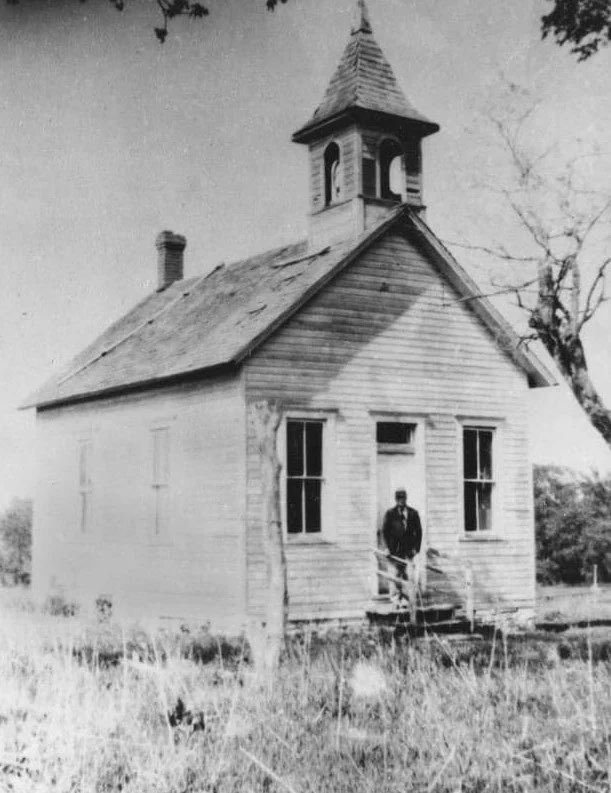
[Image: The Moravian Mission Church on the former Chippewa and Munsee Reservation outside Ottawa, Kansas. Photo courtesy of Kansas State Historical Society.]
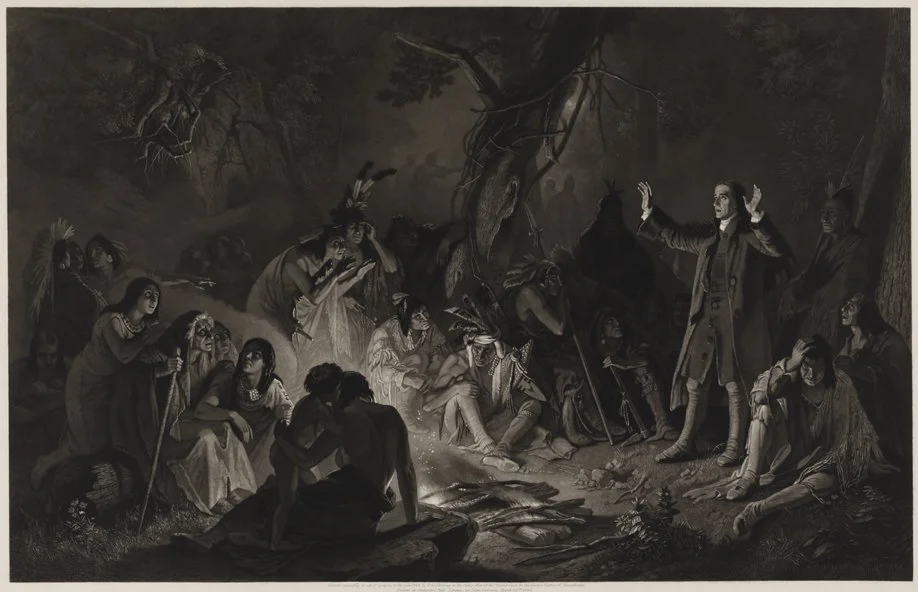
The Power of the Gospel - David Zeisberger Preaching to the Indians by John Sartain after Christian Schuessele c. 1863. Courtesy of the Pennsylvania Academy of the Fine Arts.
By 1770, Reverend David Zeisberger, one of the most influential Moravian missionaries to the United States, had made contact with the Lenape-Delaware-Munsee Tribe and established several Moravian Missions outside of Newcomerstown, Ohio. Newcomerstown, or Gekelukpechink in the Lenape language, was established around 1760 by Chief Netawatwes and was home to several large clans of the Lenape Tribe. Netawatwes is one of the most well-documented early ancestors of The Munsee Tribe in Kansas. His descendants would adopt the last name of “Kilbuck” and remain with the Moravian Church until the late 1800s, over a century from the first meeting of Rev. David Zeisberger and Chief Netawatwes. [ii]
Leading up to 1782, increasing tension between the British and white colonists created an environment of hostility against the Moravians and Indigenous Tribes. The Moravians were practicing pacifists and encouraged the Tribes living on the missions to do the same. Despite this, in 1781, British-allied Indigenous people forced the Moravians and the Indigenous Tribes, now primarily known as the Christian Indians, off their Missions and took them north to the bank of the Sandusky River to a site called “Captives Town.” They were moved before they could harvest their crops, leaving them with too few rations during the harsh winter months. Around February of 1782, some Christian Indians were permitted to return to their former Missions to harvest their crops, though most of them were destroyed by that point.
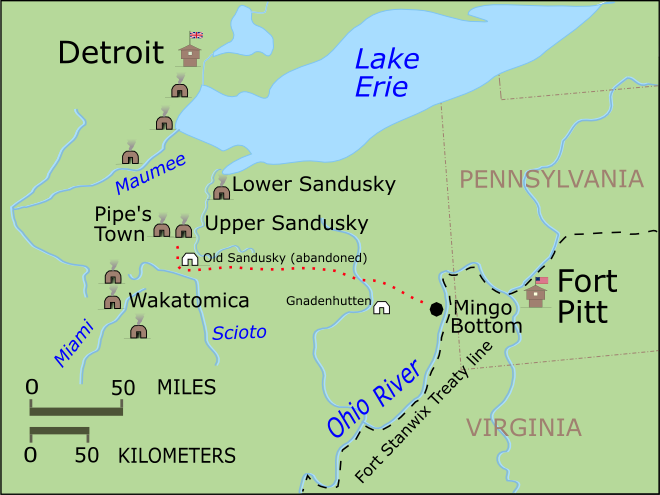
Map showing the location of Gnadenhutten (white hut) and nearby Indigenous settlements (brown huts). Courtesy of Kevin Myers through Wikimedia Commons.
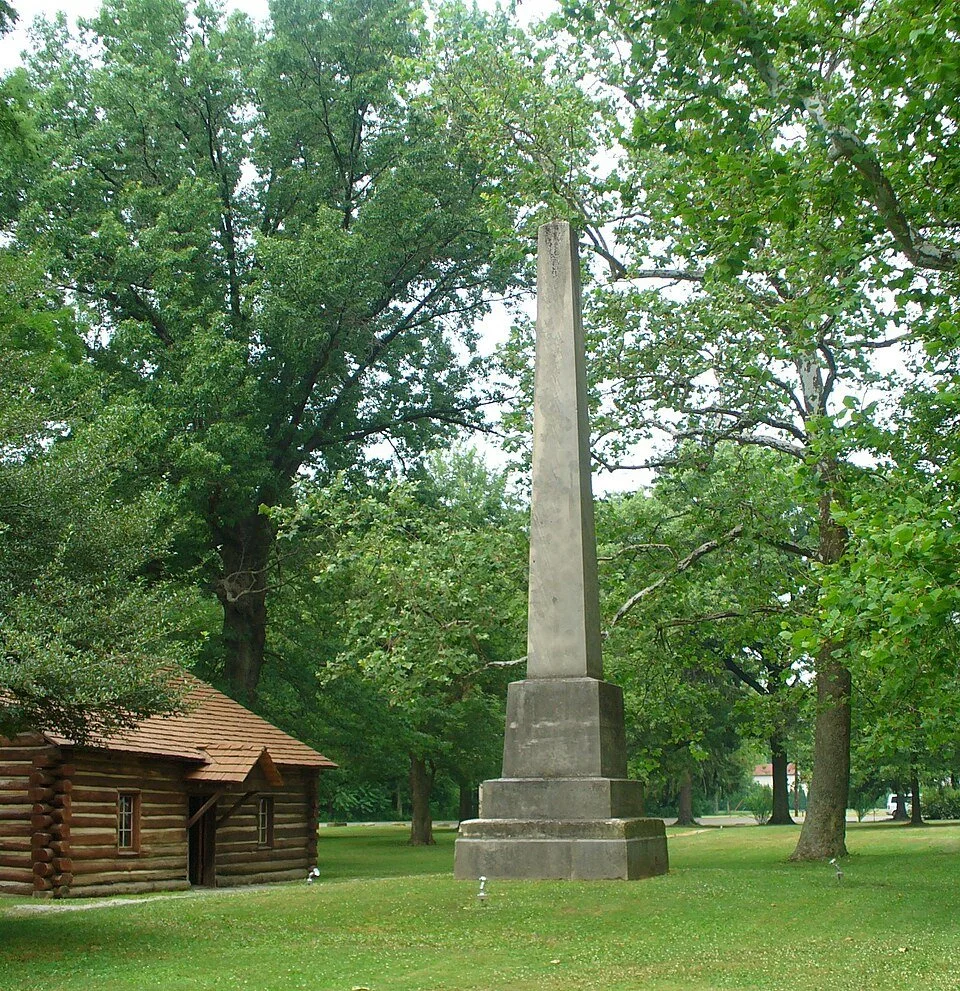
The stone monument at Gnadenhutten, erected in 1872 by the Gnadenhutten Monument Society. Photo courtesy of the Gnadenhutten Historical Site.
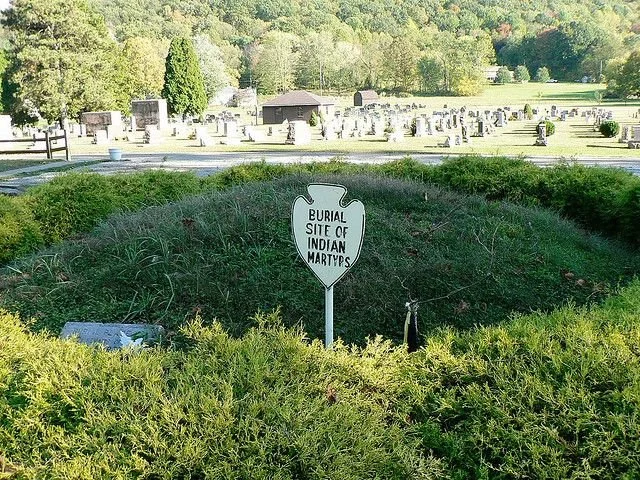
The burial mound at Gnadenhutten for the 99 Christian Indian martyrs. Photo courtesy of the Gnadenhutten Historical Site.
On March 7th, 1782, a raiding party of American militiamen arrived at the Moravian mission of Gnadenhutten from Pennsylvania. The men falsely told the Tribes that they had come to provide a safe escort to Fort Pitt, a nearby military post, where they would be protected from the American Revolution. Under this pretense, the Christian Indians handed over their hunting rifles and hatchets, and reportedly even fed the militia. A group of men traveled to the nearby Salem Mission to retrieve the Christian Indians living there and brought them back to Gnadenhutten.
Once all the Christian Indians were present, the militiamen revealed their true intentions by binding the Indigenous people and accusing them of leading raids on the white settlers and killing them. When it was clear that the militiamen would not be swayed by the Moravian’s principal of pacifism, rendering their claims false, the Christian Indians requested time to prepare and pray to God. The Tribes were divided into two cabins, men in one, and women and children in the other, and locked in to pray for the night. The next morning, the lives of approximately 99 Christian Indians were taken by the Pennsylvania militia, in what is now known as the Gnadenhutten Massacre.
15 years after the tragedy, Reverend John Heckewelder returned to Gnadenhutten, which had been burned when after the militiamen raided the mission, and buried the remains of the people there in one grave. Today, the site is a historical memorial to the Christian Indian martyrs who lost their lives that day. [iii]
Many of the members of the Munsee Tribe in Kansas descend from the children of Israel Welapachtshechen, one of the men who was martyred at Gnadenhutten.
“... they had commended themselves to God, who had given them the assurance in their hearts that He would receive their souls.”
From “A True History of the Massacre of Ninety-Six Christian Indians, at Gnadenhuetten, Ohio, March 8th, 1782.”
Published by the Gnadenhuetten Monument Society.
After the tragedy at Gnadenhutten, the Christian Indians and the Moravian Missionaries were displaced several more times over the decades. Many traveled back to northern Ohio while others went to the Moravian Mission of Fairfield in Ontario, known today as Moraviantown. In late 1830, they received an invitation from the Delaware Tribe, who were closely related to them through the Lenape, to come and live with them on their reservation in Kansas. By 1837, the Tribe arrived and made their new home at the mouth of the Kansas River, near the junction of the Missouri River. Today, that is near Kansas City but was within Fort Leavenworth’s sphere of influence. Some of the children of this group attended the Shawnee Indian Mission School just outside of Westport, alongside other children from different tribes in the area.[iv]
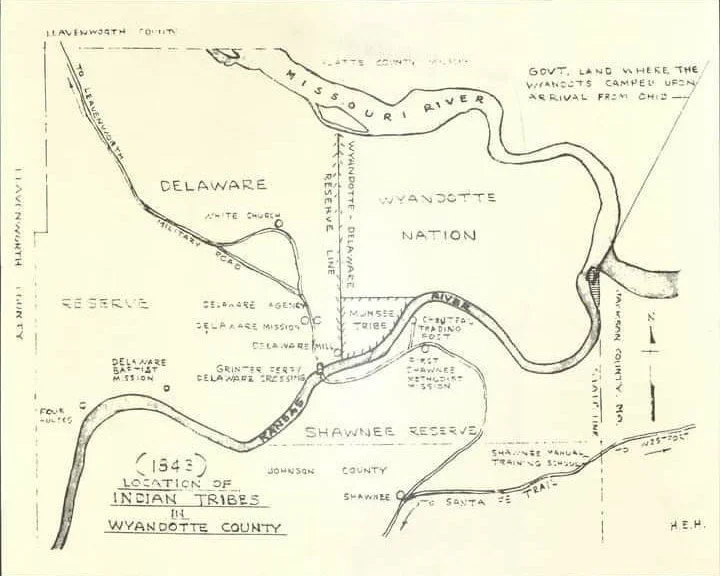
An 1843 Map with the locations of the Indian Tribes in Wyandotte County. The Munsee allotment is located near the center of the map, in a bend of the Kansas River. Photo courtesy of the Wyandotte County Historical Museum.
Around the 1850s, the Delaware decided to sell a portion of their reservation to the Wyandotte Tribe. While surveying the land to be sold, it was discovered that the new mission fell into this portion, and the Christian Indians, now most referred to as the Christian Munsee or just the Munsee, were forced to move again. They were granted time by the Wyandotte to find a new place to live, though this process had significant delays due to poor cooperation by the United States Government. [v] In 1853, the Munsee moved to a new mission called Renew or Shekomeko, though this mission was short-lived. The Munsee were extremely poor and required assistance from the government and missionaries to subsist. They also faced significant pressure from the uncertainty of their future and the growing presence of violence from white squatters and speculators on their land.
In 1859, the Munsee moved for the final time to a reservation in Franklin County, Kansas, just west of what is today Ottawa, Kansas. The Moravian mission there was deemed “New Westfield,” and a mission house was built to serve as a church and school during the early years of the mission. The records kept by the Moravian Missionaries, specifically in Church Books and correspondence from missionaries back to Bethlehem, PA, have been vital to understanding the history of The Munsee Tribe in Kansas. Through these records, The Munsee Tribe in Kansas has been able to build a significant archive of primary documents, correspondence, and genealogy from and about the ancestors of the Tribe.